Archive for the 'carbon' Category

Green Shoots at Microsoft: Public Sector Engagement: EU, UK

As I have written previously, Microsoft is finally beginning to pull together a coherent green story under new sustainability supremo Rob Bernard. The company is also missing a bunch of tricks, but more on that later. But back to the good. Yesterday came news that Microsoft is signing a non-exclusive five year deal with the European Environmental Agency (EAA) with a goal to “make environmental information more accessible to citizens in Europe”. A laudable goal. As I have written before We Are The Watchdogs. But in order to be watchdogs we need open data, transparently collected and shared. Its somewhat ironic that Microsoft is providing its services and software for free; given the EU sometimes has an issue with freebies. It will be interesting to see whether the EEA’s new web presence still uses Google custom search like the current one. The first step is to build a Web 1.0-style publishing portal, which will be based on the usual Microsoft middleware, and some Microsoft Live services, such as Virtual Earth. The EAA has wider ambitions that just publishing data however. According to the press release Professor Jacqueline McGlade, Executive Director of the EEA said:

“This collaboration is a first of its kind to establish a two-way communication on the environment. Until now, authorities, including the EEA, have communicated their data to the public. But local observers, who are often the first to notice real change in their environment, had difficulties sharing their observations with others. This partnership will provide them a platform to do exactly that”.

Likesay, this is pretty much a canonical Greenmonk story. We are all watchdogs, we are all observers. Science progresses most effectively when research and data are widely distributed. Over 500 million people-that’s a lot of eyeballs. Interestingly enough the EAA is including Turkey in the scheme - so its taking the long, wide view. The EAA has a 13 year history of Open Data, such as making greenhouse gas information available to all, but normally focuses on EU policymakers, rather than citizens. Its great to see them turning the funnel the other way…

In other Microsoft related eco news, brought to my attention by Dominic Campbell, the first social media manager at a UK local authority, Wakefield Council saves over £4m while cutting carbon emissions.A skeptic might say this story was just greenwashing, but at Greenmonk we tend to focus on outcomes, rather than looking for hyprocrisy. As Jamie Hailstone writes: “the council will save more than £4m and cut carbon emissions by 35 tons.” There is a virtuous circle created by marketing efficiency as green. Green is Lean. Microsoft’s virtualisation team could learn a lot from the case study - there is nothing wrong with quick wins. Final bonus link: check out this sexy story about Virtual Earth running on Wind powered-servers.

Repak launch Carbon Calculator using AMEE

We here at GreenMonk have written about AMEE several times in the past because we really support what they are doing (quick reminder - they enable any climate campaign to use a common standard for Carbon-Footprint Profiling and Measurement, for more, check out their FAQ).

Recently I’ve been delighted then to note that Repak have started to use AMEE’s services. Repak are an industry funded organisation based in Ireland. Repak was created to help grow packaging recycling in Ireland and to aid businesses comply with their legal obligations to fund the recovery and recycling of the packaging on the goods or services they supply, as set out in the Waste Management (Packaging) Regulations 2007(pdf).

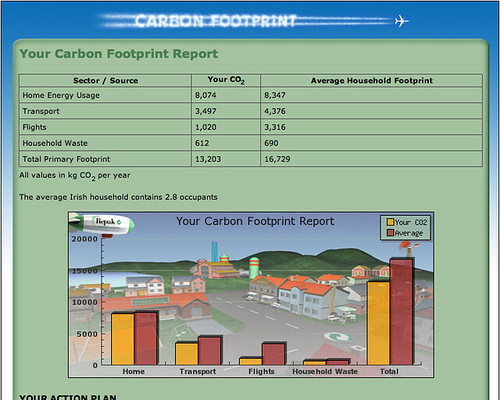
Repak have just launched an easy to use household Carbon Calculator using AMEE’s backend. Answer a few quick and easy questions and you are presented with a report outlining your current carbon footprint.

Repak.ie's Carbon Calculator

As well as estimating your carbon footprint, you also get a comprehensive series of recommendations on ways to reduce your CO2 emissions with handy information and tips such as:

  • turn down your thermostat by just one degree - each degree drop can reduce your bill by 10%
  • think about the temperature on your immersion heater - can you reduce this by a degree or two?
  • as much as 15% energy (and CO2) savings can be achieved by turning down the brightness and contrast levels on your TV
  • a laptop, on average, consumes around 30% of the power of a desktop, whilst in ‘on-mode’.
  • a well-filled A-rated dishwasher load once a day will be more efficient than many kitchen sinks full of hot water, or a running tap, to wash many dishes
  • digital radios consume up to 5 times the energy of a traditional analogue radio.
  • travelling by rail will result in about a third of the CO2 emissions of the equivalent domestic or short-haul flight in Europe. A similar journey for two people in an average-sized car would result in under two thirds of the CO2 emissions compared with flying

This is a really cool resource to help people realise the impact their day-to-day activities are having on the environment. More importantly though the calculator goes the next logical step and gives practical advice on how to reduce those Kgs of CO2.

Data Center Energy Efficiency: money in the bank

Barclays Bank and technology provider HP have just signed a deal to roll out new cooling technology at Barclays’ new Gloucester data center. According to the press release

HP’s Dynamic Smart Cooling (DSC) solution contributes significantly to a package of energy saving measures which will allow Barclays to save up to 13.4% of total energy used for its data centre. These energy saving measures will significantly reduce its carbon footprint by approx 7470 tonnes of CO2 per year.

Barclays joined the CBI climate change task force last November. Its climate change targets for 2006-2010 include:

• Reduce CO2 emissions by 20 per cent by 2010 (using 2000 as the baseline year)
• Reduce carbon intensity from 16.8 tonnes to 12.9 tonnes CO2 per £m of UK income(using 2005 baseline.) Carbon intensity is a measure of emissions relative to business growth and it allows comparisons to be made between companies.
• Reduce energy consumption in offices and branches by 20 per cent per employee (FTE) (using 2005 as the baseline)

The data center is as good a place as any to start, but it would be interesting to hear more about Barclays energy efficiency plans for its large real estate portfolio.  I also think its a shame that Barclays isn’t putting a pounds sterling figure on potential savings. To be a beacon for others it needs to translate the technical gubbins and low carbon talk into simple bottom line improvements. Shouldn’t be that hard for a bank. On the other hand of course, your carbon mileage may vary (that is, energy prices will certainly change).

According to Greenbang the big Wall Street investment banks, in conjunction with a number of energy companies, have also made some useful progress in establishing best practices for energy investment with a Carbon Principles scheme.

This effort is the first time a group of banks has come together and consulted with power companies and environmental groups to develop a process for understanding carbon risk around power sector investments needed to meet future economic growth and the needs of consumers for reliable and affordable energy.

JPMorgan, one of the banks involved, this week made its own bold gamble in carbon trading, acquiring ClimateCare, a British company that pioneered carbon offsetting. According to the Guardian ClimateCare “makes reductions of greenhouse gases such as C02 on behalf of individuals and companies around the world, and invests in wind power, hydro power, biomass, human energy and cooking-stove projects in developing countries.”

Like many others I am very skeptical of current approaches to offsetting. The idea that I can fly as much as I want as long as I later pay my absolution: “It’s not just about confession and saying my Hail Marys.” That said, its clear that the mechanism businesses find most compelling, to the point of fetish, is that of the market. Markets are a religion for some people, and they are the people with money to invest. Carbon trading could end up defining business in the 21st Century in much the same way that oil consumption defined the 20th.  I am not alone - according to S2 Intelligence businesses will spend $595 billion by 2010 on systems to support green accounting (yet again thanks Greenbang). Or as Computerworld puts it Green IT spend to outstrip Y2K within two years.

Finally I would just like to say JPMorgan’s research arm should be strongly applauded for making some of its climate-related research publicly available, for example this study into Europe, airlines and climate change targets.As I have argued before wider access to solid information is key to better outcomes. Well done old blue blood Wall Street bank.

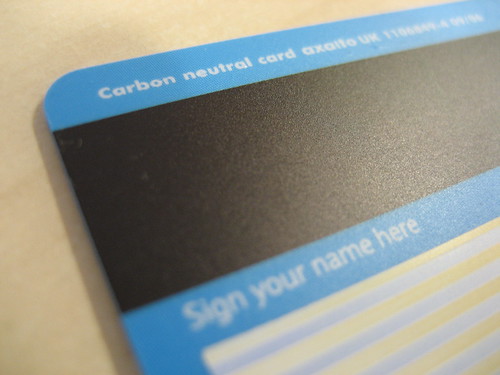
Regarding the photo above I had not heard of carbon neutral bank cards before- this one from Barclaycard. Thanks very much sh1mmer for allowing me to use the photo with a Creative Commons Attribution 2.0 license.

The 2% Solution: Impact of IT, The New Low Carb Diet

I recently blogged about a figure I had read, that emissions due to IT were in the region of 2% of global totals, but couldn’t find/remember the source. Well the number just popped up again, thanks to a heads up by Local Government 2.0 maven (and RedMonk community platinum card holder) Dominic Campbell.

The estimate in question came from a report by Intellect, a UK technology industry trade association. The report, High Tech: Low Carbon, aims to “set out the issues relating to the energy demands of products and services together with a clear action plan for the sector to address them.”

According to the report, the energy use related to ICT (information communications technologies) currently accounts for about 2 per cent of global carbon dioxide emissions. If all else remained equal, a straight-line projection based on growth in both sectors would suggest that by 2050, we could see a five-fold increase in emissions related ICT and a six-fold increase in the emissions related to consumer electronics (CE).

However, we are already seeing massive improvements in the energy efficiency of both sectors, which is already helping to mitigate this risk. Intellect believes the industry can exceed the target set by the CBI Climate Change Task Force for a 30 per cent improvement in the efficiency of electrical equipment by 2030.

Its good to see some positivitity here, some of it even warranted. IT can indeed make massive strides in improving efficiency. Indeed- the entire industry has been arguably doing the opposite for the last 40 years, so there is plenty of room for improvement. The PC era was about unfettered abundance machismo, as was Internet version 1.0. But what comes next will be working with constraints. Speeds and feeds never remotely considered efficiency, except perhaps in odd places like mainframe I/O.

Perhaps unsurprisingly a vendor-led IT consortium supports IT accounting. As far as I am concerned though they are responding to a need, not inventing one. I am going to read the full report and comment some more but in the meantime I just wanted to flag the number for myself, and people like Dennis Howlett.

IT needs to get its act together, but so so other industries. Well done Intellect for putting a stake in the ground on the 2%, but thinking about the other 98. Lets get on that Low Carb(on() Diet.

Green is a form of Lean

Many of us are thinking through the implications of greener supply chains.

Al has been giving it some lately, for example, with his thoughts on the Carbon Added Tax. Over at SAP Research Andreas Vogel is leading the charge. IBM is doing some solid work here, as is BT. But we’re beginning to see a potential backlash, based on the Greens are Dreamers frame. The argument is that green thinking and approaches will be jettisoned as economic conditions toughen. But is that necessarily the case? Jason Busch from SpendMatters nails it in a post entitled How Will Green / Sustainable Procurement Play in a Recession?

While it would be easy to dismiss green and sustainable procurement practices as a luxury for companies to invest in when times are good, I actually believe that they could help organizations to buoy their top lines and pull up from a spiraling downturn or period of contraction. Whether it’s better marketing the benefits of green supplier practices to customers to spur pent-up demand or making investments in supplier development initiatives which reduce unnecessary packaging, supplier-focused sustainability initiatives have the potential to drive sales and reduce cost.”

I hold a similar line: it seems daft to argue, as the Bush Administration repeatedly has, that efficiency efforts harm economies. Efficiency can help you cut cost, even if (especially if?) its energy costs we’re talking about. Jason gets some great comments on his post. For actionable advice why not try Paul Gooch’s suggestion:

A former employer of mine ran an internal initiative called WRAP…waste reduction always pays. This applies as much to purchasing as any functional activity. The benefits go straight to the bottom line, and in the process you reduce your energy usage, carbon footprint, etc

But Lisa Reisman really distills the arguments to 100% proof: “green is a form of lean”. Thinking about carbon consumption is not just protectionist sabre-rattling: its an efficiency argument. It strikes me at the moment many economists and business commentators just aren’t thinking through their positions. We’re seeing rhetoric as the primary argument. Greens are luddites. Localisation means a return to the stone age. And so on. Green is a form of lean.

The implications for software and services companies are clear - keep investing in Green, recession or not. You can always change your marketing to read “cost-cutting”. If however you’re relying on a return to abundance as a primary planning assumption you could be in major trouble. Spend matters green or not.

On CES, Greening, and Gizmodo as Eco-Pranksters

0

Its a laudable goal CeBIT would begin the long road to greening by fully supporting the Climate Savers Computing Initiative. But I should point out the power used at trade shows is just absurd - all those banks of screens talking to nobody in particular.

Should we should reconsider the Gizmodo guys as eco-pranksters (have you seen the video, where all the huge screens start turning off, one after another? Maybe they should join the Green Forge.) I still don’t really understand why so much anger was directed at Gizmodo, people talking about lawsuits and so on. Annoying yes. Business threatening- come on people, get some perspective.