Archive for the 'carbon' CategoryPage 2 of 4

On Small Changes, Small Cars, Tax and Pollution

It’s fair to say that encouraging people to change their behaviour in small ways can have a big impact - cumulatively - on reducing carbon footprints and environmental impact in the long-term.

But how Governments and authorities manage and cajole the public to change personal behaviour can be a problematic process – and something that’s difficult to get right. One obvious avenue available is to incentivise change by introducing tax-breaks on ‘environmentally friendly’ products and services, and hiking tax on high-polluters. That seems to be the idea behind planned changes to the Congestion charge policy in London, which - rightly or wrongly - from next year, is being turned into an environmental charge based on carbon dioxide emissions from cars.

You can read more about it in detail here, but in short, the plan is that whereas currently nearly everyone pays £8 per day, by 2009, cars which emit more than 225 g/km of CO2 will be charged £25 ($50) a day to drive into central London. Ouch. But the flip side - the ‘tax-break’ - is that if you drive a car that emits less than 120g/km of CO2, then access is free. The idea is to move people from gas-guzzlers to eco-friendly fuel-sippers, and thus see CO2 levels in the city fall. Nothing wrong with that you might think, but there’s a potential flaw…

Sales of these small, ‘sub-120g/km’ cars are soaring across the south-east of England. A new report by CEBR (report not available openly) suggests that this ‘environmentally-driven’ policy could actually end up causing CO2 levels to rise. That’s because it’s predicted the changed system will have a net result of up to 10,000 extra cars a day entering central London. And that can only lead to an increase in congestion, and a slow down in traffic speeds. As anyone who understands the internal combustion process will tell you, the problem with (even highly efficient, and small) engines, is that they’re at their least efficient when the car is sat stationary or moving at low speeds. So despite the fact that most of these additional cars will be classified as ‘environmentally friendly’ and driving around congestion charge-free, the extra traffic and congestion they create could mean CO2 levels actually rise.

Kit like this will unsurprisingly fall into the £25-a-day bracket come next year

You will, doubtless, be surprised to hear that kit like this will cost £25-a-day to drive in central London come next year…

Whether the report’s predictions prove true, only time will tell. One potential caveat to consider is that it was commissioned by Land Rover – who aren’t exactly known for their small cars (in fact, every vehicle they currently sell falls into the £25-a-day category). In the auto-industry, nothing is ever quite as black and white as it first seems… but there’s plenty of support for it’s predictions in the form of academics for instance, who have no reason for bias.

The big questions it begs, is how governments, authorities and legislators drive a process of adoption for new, more environmentally friendly products and technologies, without having the entire process back-fire on them at ground level? The message they’re putting out to people here is ‘do this, and because you’re helping save the planet, we’ll reward you’ – but in fact, that ‘reward’ might end up having quite the opposite effect on the planet’s health. Don’t ‘reward’ people’s for changing their behaviour, and they’ve no reason to change. So the carrot-stick approach is difficult. I suspect this policy might go down in history as being one of those top-down processes, that on paper looked great - but which back-fired terribly on the ground by having precisely the opposite impact to what was originally intended. Another case which will show the need for grass-roots level innovation and adoption, rather than top-down? I think so.

by-sa

Stop The Madness: run events where your people are

I love Lisbon. Its a fantastic city. I love Portugal. Great country. But the more I think about it the more absurd it seems that IBM flew a bunch of analysts and staff there for a conference last week, particularly given that one of the key themes of event was economic greening.

The simple fact is that the great majority of people attending were from London.  The industry analyst business in Europe is not particularly geographically distributed. I don’t believe there was a single Portuguese analyst at the show. Most of the IBMers were based in London too.

I think one idea behind holding such events in various far-flung venues is to “share the love”, not favouring one geography over another. Another reason is just the loveliness of the place.

I appreciate that the analyst business is fairly unusual but many industries do travel a lot. But couldnt’ we do things closer to home? Pareto distributions are likely to indicate the best place to hold an event.

Not only would running last week’s event in London have been far less carbon intensive, but it would also have been far less impactful on our productivity and home life. Missing half days of work on either side of a journey is hardly ideal. Even worse, as far as I am concerned, is missing my family. I got home at 11:45pm, having eaten nothing but a pretty nasty British Airways sandwich, and my wife was already in bed. I don’t know about you but its nice to actually get some decompression time.

No rest for the wicked. This morning I just got back on a redeye from New York. The situation in this case was somewhat different. IBM held its US event in Stamford, Connecticut,which is in easy driving distance of most of IBM’s senior executives. What is more it is the home of the biggest and most successful analyst firm in the world- Gartner Group.

I must admit that last year I was slightly put out by the fact “we were all travelling to Gartner”. It just seemed a bit off that all of the other analyst firms, including RedMonk, had to go into Gartner territory. Today I hope I am looking at the situation in a more mature fashion. I hope fewer Gartner people had to travel either, saving more carbon miles.

So what is my call to action? Hold events where the people are. London may be more expensive than other cities, but its where most of the people in my business at least live and work. if you’re organising a conference find somewhere close to home. Don’t travel unneccessarily. You might even consider using a tool like dopplr so that you know where your co-workers are going to be at any given time,so you can reduce travel accordingly. I met a guy from IBM yesterday who was doing exactly that.

And perhaps we will all have better home lives, as well as doing our bit for our carbon footprint. It makes sense to me. What about you?


picture of the Statue of the Discoveries, Lisbon, courtesy of Welland.


by-sa

BT in perpetual motion: Living Lightly and SMB greening

BT is on a roll at the moment. Shame we can’t package its perpetual green drumbeat as perpetual motion. Seriously- what other major FTSE company is doing so much to educate different sectors on greening issues?

A couple of days ago the firm was announcing the results of an Economist Intelligence Unit study it sponsored into corporate sustainability. Now BT informs me that its launched a new SMB program called Living Lightly. The simple but effective idea behind the slogan and campaign is that small firms can make a real difference to the national carbon footprint.

Its a core GreenMonk belief that small things add up (my favourite example is Google’s adwords revenues), and it seems BT is thinking the same thing:

“Small steps – when taken by a large number of individuals - make a big difference. With 4.3 million small businesses in the UK alone, the collective impact could be incredible.”

Amen to that.

At first glance the actions BT suggests look pretty self-serving:

  1. Take up conferencing
  2. Reduce unnecessary trips back to the office by using mobile communications technology
  3. Turn off office equipment at the end of the day
  4. Recycle
  5. Take-up flexible working

But as someone that has been to Lisbon and back this week for an IBM conference that could just as easily have been held in or around London, where the great majority European industry analysts seem to work, I think there is something to be said for looking at alternatives to travel. I am not alone- I heard the other day that PriceWaterhouseCoopers employees are now being asked to make personal steps to reduce their business travel.

Here are my own suggestions:

  1. Cycle to work
  2. Unplug your mobile phone chargers when its not in use
  3. Buy local services if at all possible

BT borrows heavily from the Pledgebank Model - Tell The World I Will Do It But Only If You Help with each pledge for sustainability growing the LiveLightly tree…

You on the move? “Drive more slowly - driving at 50mph uses 25% less fuel than 70mph.”

You at work? “Bring your own mug into work and don’t use paper or plastic cups.” What - why shouldn’t drink tea out of solidified petrol?

What can I say - this is goodness. Why do I big up BT so much? Why not- it should be encouraged to do more cool stuff.  In terms of using social software and quirky approaches BT is showing the way forward. Don’t hector- encourage. Green isn’t just for big companies. We all have to make a difference.

by-sa

Greening the UK, carbon-busting through iGoogle

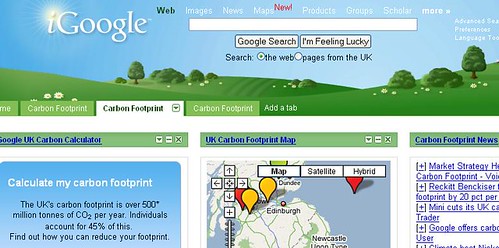
Google today gets all my love. They have just built a great interface and set of carbon-busting mashups, leveraging the AMEE back-end. You can calculate footprint, but also post videos through Sky about your own carbon-busting efforts.

According to AMEE:

Google’s implementation is based on the underlying Act on CO2 data provided by Defra and others. It makes some additional assumptions (based on data from the Energy Saving Trust) to get the number of questions down to a “manageable” few pages (specifically around appliances).

I am particularly pleased to report this initiative is driven by Google UK. sweet. Anyway- go check it out.

by-sa

Toyota as a case study in complexity. Is prius just a greenwash halo?

Great piece today at movementdesign’s re*move blog about Toyota. It tells us a lot about bright green, and the danger of kneejerk reactions. There are plenty of lessons for any industry there.

Right now there’s a petition going on in the States, calling for Toyota to support a proposed bill requiring ‘CAFE’ fleet average ‘gas mileage’ for cars and small trucks, to rise to 35mpg by 2020.  Toyota is doing its green image absolutely no good by trying to derail this bill, and supporting an alternative, which calls for the average to rise to 32mpg. Could it be that the self-styled green giant Toyota, is not as green as it likes everyone to think it is?

It seems its all about the trucks, with Prius as nothing more than window dressing.

Sadly, like everyone else auto-wise when it comes to the United States market, Toyota is actually rather keen on truck sales - specifically its big Tundra truck - which it recently launched a new version of. While Ford and GM have been taken to the cleaners by greens and press alike over their poor gas mileage, and reliance on selling inefficient trucks and their lack of hybrids, Toyota has sailed merrily on, positioning itself as the big green giant, basking in the halo effect of the Prius.

Joe though avoids knee-jerk conclusions. Its not either, or.

So although this fuel economy episode is unlikely to do Toyota’s green image much good - and although it indeed seems rather hypocritical of them to oppose the tougher gas-mileage bill, I wouldn’t kick Toyota too hard. They are ahead of the game - in terms of alternative power plants, advanced research and future mobility ideas. Just because they oppose the regulations now, doesn’t mean they won’t hit, or even exceed the legislation come 2020.

Toyota is of course undoubtedly a leader in green automotive technology, and green automotive sales, but we have to remember the company’s job is to sell as many vehicles as possible. Until it becomes deeply embarrassing to drive one of those huge trucks in environments where they aren’t absolutely necessary people will keep buying them. Toyota it seems to me is a company we should be encouraging to do better. But then signing the petition is perhaps a way to do just that.

Somehow I can’t see a computer company lobbying to reduce energy consumption targets on servers, but stranger things have happened. Environmental leadership is complex and only going to get more so.

by-sa

The Carbon Cost of The Surveillance Society

One of the things we’ll need to do if we really want better environmental outcomes is to understand the cost of things that we wouldn’t ordinarily consider, what are known in economics as “externalities”. All the stuff you don’t have actually to pay for. Fast-moving consumer goods companies (FMCG) and their packaging. Oil companies and the environmental legacy of their drilling platforms. And so on.

I found a great example of considering unexpected costs on Chris Dalby’s political rants blog. All these surveillance cameras- how much energy do they consume?

So we got all these cameras and elecronic devices like traffic ligts requireing energy being installed. This constantly increases the carbon offset requirments of the UK and drains energy sources. I have a problem with this from an environmental point of view. Just how much carbon is required to power a camera? Is this extra carbon footprint on the UK justifiable

I know I had not never considered the impact of our creeping surveillance society on UK carbon emissions. This endgadget blog mentions there being 4m such cameras in the UK (the best a quick Google search came up with). Assuming average power consumption of 50watts, that’s 200 Megawatts (MW) for UK surveillance, which is… certainly measurable. Obviously if anyone has insights into these numbers I would love to hear from you.

Chris goes on to consider street lamps too. But he also goes on to make a suggestion - compulsory solar panels on cameras and street lights. Of course these would need to charge batteries or something. There is an obvious flaw in solar powered street lamps (especially in the UK)…. but the idea of distributing power generation to take the strain off the national network and lower total emissions is basically sound.

The civil liberties crowd should maybe get out their wattmeters. One thing CCTV is really good for. Edgy self-portraits. Thanks andyrob for the main illustration!

See more on flickr here. Bonus portrait below by s j b

by-sa