Tag Archive for 'energy use'

Google and GE joining forces on clean energy

In the above video Eric Schmidt, Chairman and CEO, Google interviews Jeffrey Immelt, Chairman and CEO, GE.

The reason Google and GE were talking? Google and GE jointly announced the other day that they are coming together “to help develop tomorrow’s power generation, transmission and distribution — known as the “smart grid” — and its interface with next generation electric transportation”.

From the release:

The existing U.S. infrastructure has not kept pace with the digital economy and the hundreds of technology opportunities that are ready for market. In fact, the way we generate and distribute electricity today is essentially the same as when Thomas Edison built the first power plant well over one hundred years ago. Americans should have the choice to drive more fuel efficient cars – or even electric cars - and manage their home energy use to reduce costs, and buy power from cleaner sources, or even generate their own power for sale to the grid.

We all receive an electricity bill once a month that encourages little except prompt payment. What if, instead, we had access to real-time information about home energy use? What if our flat screen TVs, electronic equipment, lights and appliances were programmed to automatically adjust to save money and cut energy use? What if we could push a button and switch the source of our homes’ electricity from fossil fuels to renewable energy? What if the car sitting in our garage ran on electricity – the equivalent of $1 per gallon gasoline – and was programmed to charge at night when electricity is cheapest?

This is spectacular news! GE are the largest player in the power industry in the US. Their product line covers every aspect of power generation, transmission, distribution and consumption. And GE have an enviable record in renewables. They are the largest manufacturer of wind turbines globally having purchased Enron’s wind business out of bankruptcy for $300m and turned that into an asset generating between $7-$8bn in 2008!

Google get Demand Response. Coming from an Internet background as they do, they know all about the read/write web, p2p and publish and subscribe mechanisms - these are going to be the cornerstone of Electricity 2.0 as espoused by Eric Schmidt and Google in their release, and by me as I write about them regularly on this blog!

In fact, I am giving a talk at the Web 2.0 Expo in Berlin on Oct 23rd entitled “Electricity 2.0 - Using The Lessons Of the Web To Improve Our Energy Networks” - this builds on the Keynote I gave there last year on using demand response to reduce our carbon footprint.

by-nc-sa

Trilliant’s Bill Vogel on Smart Grids, Demand Response and Investment

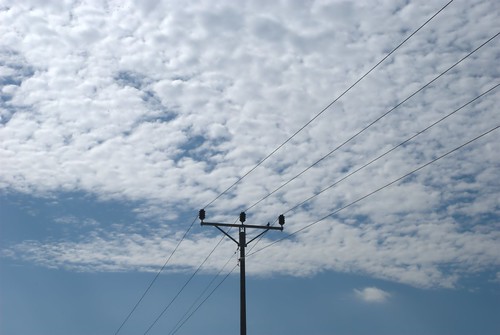
Electrical grid
Photo Credit ogimogi

Audio clip: Adobe Flash Player (version 9 or above) is required to play this audio clip. Download the latest version here. You also need to have JavaScript enabled in your browser.

Episode 3 of the GreenMonk Podcasts - 42 mins 47 secs

My guest on this podcast is President, Chief Executive Officer, and Founder of Trilliant Bill Vogel. Trilliant are a company that

provides intelligent network solutions and software to utilities for advanced metering, demand response, and smart grid management. With more than twenty years experience solving meter communications needs, Trilliant focuses on the adoption of open standards-based technologies for electric, gas, and water utilities.

And Trilliant recently announced that it had closed a $40m funding round so I was interested to know how Bill felt smart grids could help reduce carbon footprints. I invited him to come on the show to discuss this and also to answer questions I solicited from readers of this site.

Here are the questions I asked Bill and the approx. times I asked them:

For anyone who is not sure what a Smart Grid is, can you give us a quick Smart Grid 101? - 0:18

How does that differ from the current grid infrastructure that we have? - 01:12

How does that work? - 02:22

And why would that be of benefit to consumers? - 03:48

Questions from readers:

Asa Hopkins
In the Trilliant vision of the future, what level of access will an individual consumer have to their own energy data, and with what time resolution? Will they be able to export raw data? Manipulate it through Trilliant software? Compare with neighbors? In the future will there be an open ecosystem of tools to allow individuals to learn more about their energy use and make their own efficiency gains? - 06:05

Are there intelligent enough systems right now to allow your smart meter communicate with your appliances, change your thermostat settings up or down based on energy pricing, that kind of thing, is that a reality yet or is that still a bit of a pipe dream? - 09:22

More questions from readers:

Jerry Sweeney
Trilliant sees its customers as large utility companies. Does Bill see any path where electrical grids could become more democratised. Where dynamic pricing could facilitate the sale and purchase of electricity by small consumers and producers depending on the current real time price. This could lead to huge growth in the production of distributed renewable energy and to the growth in demand response to pricing signals that suggested scarcity or abundance. How can the grid become more like eBay given the stranglehold that TSOs and Utility companies have over it. - 10:21

Are any of the utilities thinking of Demand Response in respect to demand stimulation and not just the traditional peak shaving? - 16:34

Still more questions from readers(!):

Andy
-Is there any evidence that information on its own is enough to change consumption? - 18:43
- Is multi-utility metering a real prospect/ has this been done by you? - 20:29
- Is there added value in a ‘Utility Data Channel’ that could be used for Security Systems, Water/Gas/BioHeat/Oil/Sub metering/ equipment control? - 21:47
- Is there interest in Smart Grids from makers of Electric Heating, Micro CHP, and Energy Storage Technologies? - 23:18
- Has electric heating been integrated with the operation of smart grids before? - 24:46
- Can such systems be modular and expandible? - 25:13
- Can open standards have a role in maintaining the long term value of smart metering infrastructure? - 26:00
- How can smart metering support markets in carbon reduction? - 27:45
- What happens if we do not do a form of advanced smart metering in Ireland, what is a worst case? - 29:39
- If Ireland is pioneering high levels of grid wind penetration, which other countries may follow? - 31:26
- How may energy prices impact on your business, is your technology a hedge against rising prices? - 32:28

Mr Energy Rating
What is Trilliant’s definition of the minimum functionality required for a meter to become a smart meter? - 34:07

How fat do the data pipes need to be between smart meters to have a real smart-grid? - 36:47

How do you overcome consumer rejection of Demand Response and avoid the situation in California where a major DR program had to be shelved because of a consumer backlash? - 38:35

You are heavily involved in the HydroOne project in Ontario - what have you learned from such a big project? - 39:50

Final question - you recently announced that you closed a $40m round of funding - what are you going to do with $40m? - 41:28

Download the entire interview here
(39.2mb mp3)

by-sa

IBM’s Vik Chandra on how software can help reduce your carbon footprint

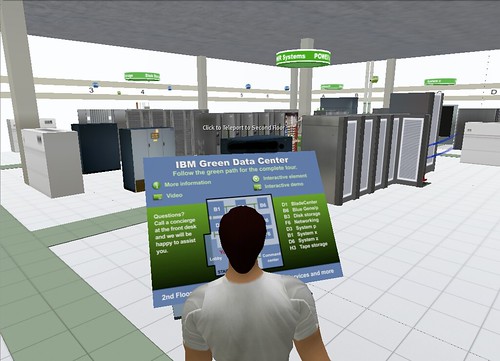
IBM Green Data Center in Second Life
The IBM Green Data Center in Second Life

Audio clip: Adobe Flash Player (version 9 or above) is required to play this audio clip. Download the latest version here. You also need to have JavaScript enabled in your browser.

Episode 2 of the GreenMonk Podcasts - 27 mins 27 secs

My guest on this podcast is IBM’s Vik Chandra. According to IBM Vik

is currently responsible for Market Management and Strategy for IBM software offerings that enable organizations to reduce their energy consumption and environmental impact. IBM’s software group offers middleware from its Tivoli, Rational, WebSphere, Lotus and Information Management brands.

I was interested to know how Vik felt software could help companies reduce their carbon footprint so I invited him to come on the show to discuss this and also to answer questions I solicited from readers of this site.

Here are the questions I asked Vik and the approx. times I asked them:

It is easy to see how more efficient hardware can help drop a company’s energy use but how is software helping companies reduce their carbon footprint? - 00:20

Demand response - the ability to have devices adjust their settings dynamically in response to pricing signals from utilities etc is recently gaining a lot of attention. Is this something IBM are looking into? 03:23

Questions from readers:

Chris Dalby
Are there any plans to expand the current cost craze that has hit Hursley? With rising energy and utility costs in general, are there plans to help companies intelligently manage and automate their energy infrastructure using mqtt? - 05:57


Alan in Belfast

As CPU/core speeds increase, software has become more and more processor hungry, driving up heat, fan, power etc. Energy efficient machines - even Eee PC 1000s! - start to alter the processor speed to keep power demands down. Are IBM serious about de-bloating their software to make it more light-weight? And do they have any feel for whether that could make a 1% difference or a 20% difference to desktop/laptop/server power usage? - 08:14

Is it more efficient to build features into hardware or software? A lot of the enterprise monitoring software that gets installed to instrument PCs/servers runs continuously. Better to make lighter hardware modules to do the same? Is there a day when a Linux-on-a-chip (etc) will be embedded in PCs/servers as a more energy-efficient method of performing these tasks? (Bring back the PIC chip!) - 10:28

Jim Spath
We’re moving toward more virtualization, currently running IBM AIX on Power5 LPARs, starting to run virtual CPUs, memory, storage and I/O. What are the limiting factors for software licensing in such a landscape? It seems we save money on hardware but pay more for software that could run in different frames.
I think Linux is a partial answer, but there are corporate concerns with having multiple OS images, not to mention uneasiness about GNU and BSD license models. - 14:23

Jim Hughes
I see plenty of power management software going into desktop and laptop PCs (clock slowing, fans that run only when necessary etc.), but precious little into servers.

As many enterprises appear to be shuffling ever more equipment into noisy, over heating server rooms, surely power (and noise) management should be a big issue here.

Are IBM ignoring servers because they’re hidden away from all but the long suffering sys admins? - 17:01

Ed Gemmell
Of the $1 billion IBM said they would invest in Green IT. How much has already been invested (can we see it in the financials?) and how much has been in Software. What do you have to show for the $1billion so far? - 21:31

Uldis Bojārs
It would be interesting to learn more about what is IBM’s experience and lessons learned in enterprise use of new social media and collaboration tools such as microblogging and virtual 3D worlds. - 25:58

Download the entire interview here
(25.1mb mp3)

by-sa