Search Results for: utilities

post

SAP announces two new energy management products

I attended the International SAP for Utilities event in Mannheim recently and was surprised when in his opening keynote, Klaus Heimann introduced two new SAP energy management products.

The first is a customer portal for Utility companies which helps utility companies roll out online self-service sites for their customers. This is being made available for utility companies both as a product, and as a service!

And the second is an Enterprise Energy Management application. This is a product to help large organisations better manage their energy – and as Klaus explains in the video above, by energy, SAP is referring to all forms of energy, not just electricity. And water too. SAP hopes to sell this to utility companies, so they can offer it as a service to their larger customers.

I was intrigued by the announcements so I asked Klaus if he’d go on camera to say a few words about them. See the resulting video above and the transcription below…

Tom Raftery: Hi everyone, welcome to GreenMonk TV. We are here at the SAP for Utilities event in Mannheim and with me I have Klaus Heimann. Klaus you brought up in your keynote two new announcements from SAP, two very interesting announcements, can you tell me a bit more about them?

Klaus Heimann: Yes, for sure. The first one was about customer online services. That’s easily explained. 750 million households are currently receiving bills from their utilities that are actually produced by our software. And many of these consumers now are in a deregulated market increasingly getting into the smart grid. And so the number of contacts they have to the utility is increasing and the utilities are getting very concerned about the cost of their call centers, they want to switch to internet. And our offering is here that we want to develop internet self services made-to-order for each utility as they want it, that refers back to the SAP for utilities instance that our customers are running.

Tom Raftery: So this means that the utility companies have an internet portal for their customers?

Klaus Heimann: Yes. The interesting thing is actually we can run that portal for them. And now that’s a longer story, but it’s really a not only an IT product, it’s also an IT service that SAP is thinking about to really help reducing the cost of our customers and make their consumer, customer service more attractive. The second announcement I made is about enterprise energy management. It’s not really a utilities application, it’s actually across industry application that helps big enterprises, number one to save energy, so save kilowatt hours, number two to better give —

Tom Raftery: You were explaining to me earlier this — when are saying energy, you mean, you actually mean energy, you are not talking just electricity.

Klaus Heimann: I mean energy in any kind, actually I also mean water. So primarily I mean energy like electricity and gas, it could also be oil, it could be petrol, it could be water. So we are looking to everything, but clearly the biggest savings are in the area of electricity and gas, that’s why we focus on it. And as I said it’s a cross-industry solution that helps our big enterprises to save energy and also to do a better procurement, a better planning for energy demand and we are presenting this here at this conference, because we do believe this could become a service that our utilities customers use themselves to help their big customers to improve their energy efficiency, because if the utilities don’t do it then somebody else does it, and I think it’s an attractive business especially for retail utilities.

Tom Raftery: Fantastic. Klaus that’s been great, thanks a million.

Klaus Heimann: Thank you.

Disclosure – SAP are a GreenMonk client. They paid for me to attend, produce videos from and speak at the International SAP for Utilities event.
post

Engaging people in the energy conversation

Green Numbers

I went along to the MashupEvent Energy 2.0 – Energy goes Digital get together in London last Thursday.

It was a good event with some interesting speakers, including Usman Haque of pachube, Ajit Jaokar from FutureText and Paul Tanner (self-confessed energy nut!).

The talks were good – for me, one of the more interesting learnings was how pachube is being used to crowd-source rediation readings from hacked Geiger counters in Japan! Seriously awesome stuff, and a real case of people using the pachube platform for purposes never dreamed of when it was first created, I suspect.

When the floor was opened for questions and discussion, some interesting topics were raised. When the question was asked from the podium, one brave member of the audience confessed to being from a utility (British Gas) and she went on to raise an interesting point – she said it was hard to motivate people to to make any changes. British Gas, she said, have offered people free insulation, which would potentially save them hundreds of pounds, and they don’t take up the offer.

This is not the first time I have heard these kinds of stories. Why is that?

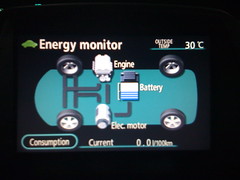
Toyota Prius dashboard driving info

Toyota Prius dashboard driving info

There are a few reasons for this, as far as I can see:

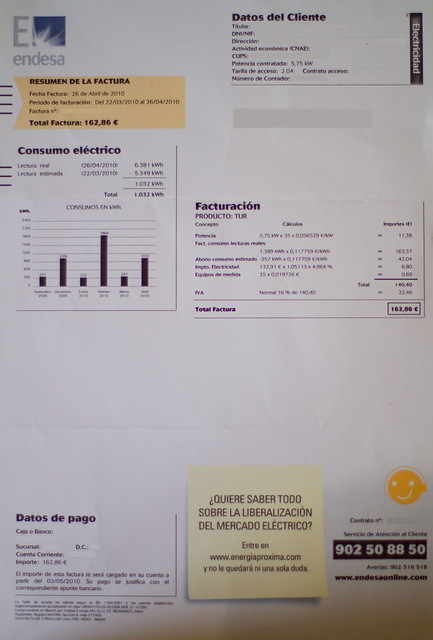
  1. When you are getting electricity bills like the one above, you have no idea what your actual consumption is like day-to day, minute-to-minute. I bought a Toyota Prius a number of years ago and it totally changed the way I drive because of how well the consumption information is fed back to me on the dashboard – the same is not true for the Honda Insight, as I discovered when Honda lent me one to trial, so not alone is it important to give people information on their consumption, it is also vital to present it in an easily digestible way.
  2. People don’t trust their utility companies – traditionally utility companies only communicate with their customers (who they often refer to as ratepayers!) when they are sending a bill or when a bill is overdue. This form of communication is not particularly conducive to establishing a good relationship. The basis for any good relationship and thereby trust is communication. Utility companies need to radically step up their customer communications, but not in a way that is spammy. They need to engage with their customers on all channels (if my preferred method of communication is Twitter, I want them to engage with me there, if my Dad’s preference is phone – talking to a person, not an IVR, then that’s where they need to talk to him). This is going to be a hard lesson for many utilities to learn but they fail to learn it at their own peril and
  3. Energy is too cheap! Possibly fixing 1 and 2 will persuade people to become more energy efficient, but I suspect, the real driver for energy efficiency will only come along when energy becomes more expensive. Only when the cost of energy really starts too impact on people’s lives, will they start to pay attention. Luckily, that’s the direction energy prices have been going for some time now!

You should follow me on Twitter here

Photo credit Tom Raftery

post

Friday Green Numbers round-up for March 11th 2011

Green Numbers

And here is a round-up of this week’s Green numbers…

  1. Progress Energy investing approximately $520 million dollars in smart grid technologies

    IBM today announced that it has been selected by Progress Energy as the lead systems integrator for the utility’s smart grid program. Together the companies will transform Progress Energy’s networks by improving power efficiency, increasing power quality and reliability, and enhancing capabilities for renewable energy, energy storage systems and plug-in electric vehicles.

    Progress Energy is investing approximately $520 million dollars in smart grid technologies through its two utilities that serve approximately 3.1 million customers in the Carolinas and Florida. The total investment includes $200 million from a read on …

  2. FIRST Green ‘e-Watt Saver’ 7W LED Lightbulb (Product Review)

    For Inspiration and Recognition of Science and Technology (FIRST) is a non-profit founded by inventor Dean Kamen over 20 years ago. It aims to inspire young people to learn about science, technology, engineering and math through challenging robotics competitions. To raise funds, they sell FIRST branded energy-saving LED lightbulbs (better than chocolate!). I had the chance to get my hands on one, so here’s my review read on …

  3. Can a Whole City Go Zero Waste?

    We’ve already seen how pay-as-you-throw trash metering can cut landfill waste in half, and we’ve witnessed whole cities make composting mandatory. So there’s little doubt that much, much more can be done by most cities to cut waste, and keep precious resources out of landfill. That’s why an announcement from my hometown that it will completely eliminate waste to landfill within three years is particularly exciting. But is it enough? read on …

  4. Carbon emissions from every public building in England and Wales

    The carbon emissions of every public building in England and Wales have been released, thanks to an FoI request by the Centre for Sustainable Energy. See what the data says about the read on …

  5. When Earth’s Human Population Was 18,500!

    Scientists have calculated that for a period lasting one million years and beginning 1.2 million years ago, at a time when our ancestors were spreading through Africa, Europe and Asia, there were probably between 18,500 to 26,000 individuals capable of breeding (and no more than 26,000). This made them an endangered species with a smaller population than today?s species such as gorillas which number 25,000 breeding individuals and chimpanzees (21,000).

    Researchers have proposed a number of explanations , such as read on …

  6. $44m Energy Efficiency savings whets AT&T’s appetite for more

    When John Schinter joined AT&T in 2009 as the company’s first energy director, he was charged with revamping the way AT&T manages energy consumption and developing programs to reduce use.
    In 2010, the telecommunications giant implemented a whopping 4,200 projects aimed at improving energy efficiency, AT&T announced today. The effort has generated $44 million in annualized energy savings, setting the stage for an even more aggressive read on …

  7. February Arctic Sea Ice Ties For Record Low As Global Snow Cover Remains High

    New data coming out of the National Snow and Ice Data Center reveals two things which may at first seem contradictory at first but aren’t: The extent of Arctic sea ice in February tied for a record low, while at the same time snow cover for January and February in the Northern Hemisphere remained extensive, ranking in the top six extents on record.

    Resolving the apparent but erroneous contradiction first, in the NSIDC’s words:
    Both linked to a strong negative phase of the Arctic Oscillation. A strongly negative AO favors outbreaks of read on …

  8. ABB wins $50 million solar order in Italy

    ABB has won a $50 million order from Phenix Renewables to deliver a 24 megawatt (MW) photovoltaic (PV) solar power plant in Lazio, central Italy.

    Once connected to the grid, the Phenix solar plant will supply up to 35 gigawatt-hours (GWh) of electricity a year, avoiding the generation of over 25,000 tons of CO2 emissions, equivalent to the annual emission of over 10,000 European cars.

    ABB will be responsible for the read on …

  9. IBM Names First 24 Recipients Of Smarter Cities Challenge Grants

    IBM today selected 24 cities worldwide to receive IBM Smarter Cities Challenge grants. The grants provide the cities with access to IBM’s top experts to analyze and recommend ways they can become even better place in which to live, work and play.

    The IBM Smarter Cities Challenge is a competitive grant program in which IBM is awarding a total of $50 million worth of technology and services to 100 municipalities worldwide over the next three years. Teams of specially selected IBM experts will provide city leaders with read on …

You should follow me on Twitter here

Photo credit Unhindered by Talent

post

Friday Green Numbers round-up for Feb 25th 2011

Green Numbers

And here is a round-up of this week’s Green numbers…

  1. After 50 Years, Nuclear Power is Still Not Viable without Subsidies, New Report Finds

    Since its inception more than 50 years ago, the U.S. nuclear power industry has been propped up by a generous array of government subsidies that have supported its development and operations. Despite that support, the industry is still not economically viable, according to a report released today by the Union of Concerned Scientists (UCS). The report, ?Nuclear Power: Still Not Viable Without Subsidies,? found that more than 30 subsidies have supported every stage of the nuclear fuel cycle, from uranium mining to long-term waste storage. Added together, these subsidies often have exceeded the average market price of the power produced.

    ?Despite the fact that the nuclear power industry has benefited from decades of government support, the technology is still uneconomic, so the industry is demanding a lot more from taxpayers to build new reactors,? said Ellen Vancko, manager of UCS?s Nuclear Energy and Climate Change Project. ?The cost of this technology continues to …

  2. UN reveals $1.3trn green strategy

    A new sustainable strategy by the United Nations proposes to invest 2pc of wealth generated by the global economy, or some $1.3trn annually, in 10 key sectors.

    The new United Nations Environment Programme (UNEP) report that was released yesterday, when more than 100 environment ministers met in Nairobi, underlines a sustainable public policy and investment path that will not only launch the transition towards a low-carbon, resource-efficient green economy, but will also …

  3. Wind generation is not increasing wholesale electricity prices in Ireland

    The growing levels of wind generation on the Irish electricity network is not increasing wholesale electricity prices, a new study published by EirGrid and the Sustainable Energy Authority of Ireland (SEAI) suggests.

    The report by grid operator EirGrid and the SEAI, employs detailed modelling tools to examine the wholesale prices in the Irish electricity system in 2011, which has a total annual value of an estimated ?2bn.

    The analysis revealed that wind generation lowers wholesale prices by …

  4. 7 Fear Factors That Move Solar Stocks

    Solar companies have seen their stocks head up over the past two months as they?ve been reporting killer sales and profits for 2010 and remain bullish about 2011. Shares of key players, such as SunPower, Suntech Power, First Solar and Trina Solar, all have seen their shares rise about 30 percent or more since the beginning of the year.

    But no stocks can keep climbing forever, and news events that …

  5. OnChip Power, aiming a shrink ray at bulky transformer ‘bricks,’ raises $1.8 million from Venrock

    I am fairly sure that if you manage to raise $1.8 million for your start-up while enrolled in a business school course called “Entrepreneurial Finance,” you are almost guaranteed an A.
    Last week, MIT Sloan student and OnChip Power CEO Vanessa Green was signing the papers on her company’s first round of funding: $1.8 million from Venrock and Arunas Chesonis, chairman of PAETEC Holding and an MIT alumnus.

    OnChip is commercializing new power electronics technology developed at …

  6. Transphorm Unveils Efficient Power Module, $38M From Kleiner, Google Ventures

    Here comes the biggest cleantech startup launch since Bloom Energy: Acompany called Transphorm has emerged from stealth on Wednesday afternoon at Google Venture?s headquarters, touting an energy-efficient power conversion module for power-hungry devices from servers to electric car batteries to solar panels, and an enviable $38 million in venture capital from Kleiner Perkins, Google Ventures, Foundation Capital, and Lux Capital.

    Founded in 2007, Transphorm is looking to make power conversion more energy-efficient and reduce the …

  7. Harvard Study Reveals Coal Energy To Be One of the Most Expensive Forms of Power

    Advocates of coal power argue that it is among the cheapest sources of energy in the United States and allows for lower-cost power. But a new Harvard study found that whatever money is saved in operation costs is completely negated by the cost coal plants inadvertently pass on to the American public: $345 billion.

    These hidden expenses are not borne by miners or utilities, but come from the detrimental side affects of coal burning, like health problems in mining communities and pollution around coal plants. The study is the first to look at the entire cost of coal, from extraction to combustion …

  8. Oil surges nears $120 a barrel on Libya and Middle East fears

    Oil prices soared to almost $120 a barrel on Thursday amid fears that the unrest in Libya and Bahrain could spread to other oil-rich countries in the Middle East, including Saudi Arabia.

    Brent crude leapt $8.54 to $119.79 a barrel, the highest price since August 2008, and later traded at $113.93 a barrel. It closed at…

You should follow me on Twitter here

Photo credit Tom Raftery

post

Friday Green Numbers round-up for Feb 4th 2011

Green Numbers

And here is a round-up of this week’s Green numbers…

  1. Europe’s Energy

    Member States of the European Union have agreed on targets aimed at reducing greenhouse gas emissions by cutting energy consumption by 20% and increasing the share of renewables in the energy mix to 20% by 2020. The ‘Europe’s Energy’ project gives users a set of visual tools to put these targets into context and to understand and compare how progress is being made towards them in different countries.

  2. Survey results: Utilities executives on Energy Efficiency and the Smart Grid

    The survey asked 106 utility executives ? the people that arguably know more about the energy supply and demand challenges our nation faces than anyone else ? a range of questions on the smart grid, energy efficiency and related topics and issues.

    We issued a press release today with some of the highlights, but to help put this week?s news into context, we also wanted to share a full breakdown of the results. Nothing earth shattering, but worth keeping in mind as the week progresses?

  3. 10 Smart Grid Trends from Distributech

    The annual smart grid event Distributech kicked off in San Diego Tuesday morning and ? as expected ? unleashed a whole series of news from smart grid-focused firms. From new home energy management products, to plug-in car software, to distribution automation gear, this is a list of trends and news from the show.

  4. US Venture Capital Investment in Cleantech Grows to Nearly $4 Billion in 2010, an 8% Increase From 2009

    US venture capital (VC) investment in cleantech companies increased by 8% to $3.98 billion in 2010 from $3.7 billion in 2009 and deal total increased by 7% to 278, according to an Ernst & Young LLP analysis based on data from Dow Jones VentureSource. VC investment in cleantech in Q4 2010 reached $979 million with 72 financing rounds. VC investment in cleantech in Q4 2010 reached $979 million with 72 financing rounds, flat in terms of deals and down 14% in terms of capital invested compared to Q4 2009.

    “In comparison to the early days of cleantech, the 2010 US VC investment results reflect a turning point in the industry due to improving credit and capital markets, the deployment of stimulus spending and increasing corporate cleantech adoption,” said Jay Spencer, Ernst & Young LLP’s Americas Cleantech Director.

  5. A jump at the pump – bad news for more than motorists

    Few trends cast shadows on economies and politicians like a rise in the cost of petrol. Barack Obama?s presidency, so far a minefield of crises, can add one more in the form of higher prices at the pump. Entering the last full week of January the average price of a gallon (3.7 litres) of petrol stood at $3.11, up 40 cents from a year earlier. Fuel has never cost so much in January, but that is unlikely to be the highest price Americans pay for it this year.

  6. Arctic Oscillation brings record low January extent, unusual mid-latitude weather

    Arctic sea ice extent for January 2011 was the lowest in the satellite record for that month. The Arctic oscillation persisted in its strong negative phase for most of the month, keeping ice extent low.

    Arctic sea ice extent averaged over January 2011 was 13.55 million square kilometers (5.23 million square miles). This was the lowest January ice extent recorded since satellite records began in 1979.

  7. Despite emails and cold winter, 83% of Brits view climate change as a current or imminent threat

    The public?s belief in global warming as a man-made danger has weathered the storm of climate controversies and cold weather intact, according to a Guardian/ICM opinion poll.

    Asked if climate change was a current or imminent threat, 83% of Britons agreed, with just 14% saying global warming poses no threat. Compared with August 2009, when the same question was asked, opinion remained steady despite a series of events in the intervening 18 months that might have made people less certain about the perils of climate change

You should follow me on Twitter here

Photo credit kirstyhall

post

Green bits and bytes for Feb 3rd 2011

Green bits & bytes

.

Some of the Green announcements which passed by my desk this week:

  1. Capgemini just announced that it can offer its utility customers deployment services, project management, technical and customer support related to Intel’s new Home Energy Dashboard. The Dashboard is a device, based on Intel architecture, that enables utilities to interact directly with consumers in the home.
  2. IDA Ireland – the country’s inward investment promotion agency reported recently that Intel and SAP are establishing a ?1.7m research and development centre in Belfast with the support of Invest NI. This is the first time that Intel and SAP have established a shared physical location with pooled resources.
  3. Both of data centre owner Telehouse’s London data centre’s have been awarded the Carbon Trust Standard. The Standard certifies that organisations have measured, managed and reduced their carbon emissions across their own operations, and are committed to reducing them year-on-year.
  4. Sentilla – a provider of software to track energy performance management for data centres announced version 3.3 of their Energy Manager application. The new version automatically records how much work is performed, how much energy is consumed, the cost of running each service, and the efficiency of each service. This enables enterprises to make informed, strategic decisions about where to run applications, how and when to virtualize, and how to get the most out of their equipment and power capacity.
  5. A new report by management consulting firm A.T. Kearney which looks at climate change actions and performance of 57 global companies and 1,000 of their suppliers across a broad cross-section of industries concludes that businesses are now seeing a return on investment from embedding sustainable practices into the procurement function. It goes on to assert that this indicates an emerging trend in supply chain engagement and collaboration.

You should follow me on Twitter here

Photo credit Tom Raftery

post

Green bits and bytes for Jan 27th 2011

Green bits & bytes

.

Some of the Green announcements which passed by my desk this week:

  1. This year’s annual Transmission & Distribution Europe and Smart Grids Europe conference will be held in Copenhagen from 12-14 April. More than 30 utilities, as well as utility experts, regulators and technology giants from all over Europe, as well as the USA, South Africa, Japan and Australia, will be attending. I hope to be there too!
  2. Synapse Energy Economics released a report this week which outlines in detail the enormous hidden health and water impacts of coal and nuclear power in the US.

    Some of the costs mentioned in the report include 200 billion gallons of water withdrawn from America?s water supply each day ? annual costs to society from premature deaths due to power plant pollution so high that they are up to four times the price of all electricity produced in the U.S. ? and four metric tons of high-level radioactive wastes for every terawatt of electricity produced by nuclear reactors, even though there is no long-term storage solution in place.

  3. Optimum Energy, maker of heating, ventilating and air conditioning software solutions, has rolled out a new partner program with enhanced project development tools and training resources. Optimum Energy’s software maximizes the energy reduction potential of high-efficiency, variable speed heating and cooling systems, leading to energy savings for customers and the ability to improve overall project return on investment.
  4. Tropos Networks, maker of wireless IP networks for Smart Grids, has added two new products to its portfolio – the Tropos 1310 Distribution Automation (DA) Mesh Router and their Directional Radio Systems to deliver economical long range, high capacity wireless communications for sparse suburban and rural areas or as backhaul for Tropos Mesh networks.
  5. New York’s Mayor Bloomberg launched an Urban Technology Innovation Center at Columbia university. The center brings together academia, the public sector and companies like IBM to design and deploy new technology that will help the city’s buildings save energy, water and other resources. The challenge is to use advanced IT systems – analytics software and powerful new hardware – to create facilities that reduce energy, streamline operations and optimise real estate use.

You should follow me on Twitter here

Photo credit .faramarz

post

Green bits and bytes for Jan 13th 2011

Green bits

Some of the Green announcements which passed by my desk this week:

  1. Invensys IMServ, a UK-based carbon and energy solution provider has launched a new programme to help UK schools increase their energy efficiency, reduce their carbon footprint and save money on their energy bills.
  2. SAP Americas was named 2010 Smart Grid Integrator of the Year 2010, North America by The New Economy.
  3. Enterprise energy management company JouleX has upgraded its network-based agentless product JEM to version 2.5. The new version supports a broader set of IT infrastructure devices, improves energy measurement and accuracy, JouleX Mobile allows employees to become more engaged in company’s sustainability initiatives, “load adaptive computing” allocates computing resources based upon system and application utilisation and has significantly upgraded its reporting capabilities.
  4. Tropos Networks, a company which sells wireless broadband network infrastructure, announced the other day that they were selected by more utilities as the company of choice for their smart grid communications infrastructure than any other vendor. Tropos’ CEO Tom Ayers, whom I video interviewed previously here, said

    I expect that 2011 will be a banner year of growth for our company and smart grid deployments globally.

    Good for them!

  5. UK based Greenstone Carbon Management made me aware recently that Asian-based investment bank Nomura have selected Greenstone’s Acco2unt carbon accounting software to help measure, manage and report its carbon emissions across the Bank?s operations in Europe, Middle East and Africa (EMEA).
  6. After a successful pilot, ARRA recipient Burbank Water and Power (BWP) has selected energy management company Trilliant to implement its smart metering communications infrastructure. Trilliant is partnering with GE for meters, eMeter for Meter Data Management, and Siemens for integration. BWP will utilise Trilliant?s solution to help manage service requests, customer inquiries, meter reading and service interruptions.

Photo credit lissalou66

post

SAP talks e-mobility!

I visited SAP’s facilities recently on their energy efficiency day and talked to them about their e-mobility initiatives and the rollout of their 16 Coulomb Technologies electric vehicle level 2 charging stations for their employees.

Tom Raftery: Hi everyone! Welcome to the GreenMonk TV. With me, today, I have Geoff Ryder from SAP and Henry Bailey also from SAP. Guys, we are at the SAP headquarters, here, in California, Palo Alto, because Geoff ?

Geoff Ryder: So, we started earlier this year taking a survey of all of our employees and are they interested in electric vehicles. It turned out they are. About 200 said they are in the market for one. So, how can we deal with that as a company? We can take advantage of that to show sustainability, thought leadership, we can also make this appealing to our employees, appealing place to work. So, you?re seeing today the culmination of our planning process. We are deploying 16 Coulomb Technologies charging sessions. These are level 2 charging stations, they?ll be across campus. And we?ll also —

Coulomb Technologies Level 2 electric vehicle charging station

Coulomb Technologies Level 2 electric vehicle charging station

Tom Raftery: Level 2 charging stations, means what?

Geoff Ryder: It?ll be 240 volts, that?s the voltage that you run your dryer off of. So, that?s very capable. It can charge the battery in a faster time than if you trickle charge with 120 volts. So, we think that?s probably the way it?s going to go. People will want to see that in their public charging option. Even at home, I think we?ll see you know Level 2 charging stations coming.

So, today, we?ve actually turned our first charging stations on and as you can see we have a small fleet of electric cars here.

We have our partners from Nissan with LEAF. We have a plug-in Hybrid Prius, we have a Chevy Volt, and further down, it?s hard to see, here but we have a CODA Automotive, a demonstration car.

Tom Raftery: Okay.

Geoff Ryder: Yeah.

Tom Raftery: Henry you?re involved with the e-mobility solutions, so ?

Henry Bailey: Correct.

Tom Raftery: What?s that exactly?

Henry Bailey: So, what we have done is we have looked at — as Geoff mentioned, we?ve got our employees interested in electric vehicles.

We also have a lot of our customers interested in the how to deploy electric vehicles primarily utilities looking at how do they manage the infrastructure when these vehicles start showing up in their service territories.

So, as people buy electric vehicles, they drive them home, now suddenly they?re plugging them into the Grid, which in some cases using the Level 2 charging station that Geoff described could look like another small home being plugged into the Grid.

So, the Utilities have a couple of opportunities, they need to look at how do they manage this new load coming on to the Grid and then also with the purchasing of energy by the home owner and maybe by third parties who are offering these charging stations at retail outlets, parking garages of businesses how do they, basically, settle those charges back to the consumer so that they can, basically, charge anywhere they want roaming freely around the country if you will.

Tom Raftery: The example being, if I go to the local supermarket and plug-in there, how does that charge appear on my electricity bill?

Henry Bailey: Exactly, but there may be different types of settlement options that the consumer wants. They may want it come back to their home energy bill as a separate line item, so they can see exactly what their energy usage is both when they plug it into their home as well as when they are roaming around to different shopping malls, grocery stores, as you are talking about.

They may also want to settle it to the credit cards, they may want to settle it to cell phones and have it as a part of that infrastructure. So, we?re looking at all different options and we also see businesses taking advantage because – take the mall, for example. If you can attract people with electric vehicles to come and stay maybe an extra hour or two giving them some sort of incentive to stay that hour or two by either the convenience and/or electricity at maybe low or no cost to them directly, then that entices them to stay longer, shop more.

So, they?re looking at it as a way to incent the customers to come and visit their place of business.

Tom Raftery: Excellent. Guys, thanks very much.

Geoff Ryder: Thank you.

post

Friday Green Numbers round-up 11/19/2010

Green Numbers

And here are this week’s Green numbers…

  1. Smart grids could save the EU ?52 billion annually, according to leading smart grid companies that have teamed up to promote European leadership in smart grids.

    The sizeable savings would arise from reducing losses in the electricity distribution network through automation and encouraging consumers to cut energy consumption with smart meters that provide more accurate and timely information, experts from the Smart Energy Demand Coalition said at its launch yesterday (15 November) in Brussels

    Utilities will also be able to lower the system voltage level and make meter-reading redundant, argued Chris King, chief regulatory officer at eMeter. After deducting necessary costs like the installation of smart meters and new software, the net benefit would still be ?31 billion per year, he said.

  2. Exelon Corp. plans to invest $3 billion to boost the output of its nuclear plants as environmental regulations make competing coal-fired generation more expensive.

    The investment is part of a plan announced Tuesday to spend $5 billion between 2010 and 2015 to increase generation capacity and reduce the company’s carbon footprint.

    The company already has the lowest carbon footprint of any major power producer because 93% its power is generated by its huge fleet of nuclear reactors, which emit almost no carbon dioxide. As Exelon increases its output of nuclear power, the company will close a pair of money-losing coal plants in Pennsylvania.

  3. To reduce emissions of greenhouse gases 10 percent below 1990 levels, Oregon?s PGE (Portland General Electric) plans to replace coal plants with 2,362 MW of wind energy and 557 MW of simple-cycle combustion turbines burning natural gas

    To pay for the new investment in building renewable energy, utility rates will likely rise 13% in 2019, and 25% in 2020, the utility calculates.
    But the other utilities in the state that utilize the regions plentiful hydro can make a gentler transition, as they currently have surplus generation from clean sources in the spring and winter.

  4. The Carbon Disclosure Project launches first water disclosure report on world?s largest companies

    The report findings show that water is already impacting business operations with 96% of responding companies able to identify whether or not they are exposed to water risk and more than half of those reporting risks classifying them as current or near-term (1-5 years). 39% of companies are already experiencing detrimental impacts relating to water including disruption to operations from drought or flooding, declining water quality necessitating costly on-site pre-treatment, and increases in water prices, as well as fines and litigation relating to pollution incidents.

    Water security is already high on the corporate agenda with 67% reporting responsibility for water-related issues at the board or executive committee level. The majority of companies (89%) have already developed specific water policies, strategies and plans, and 60% have set water-related performance targets.

Photo credit millicent_bystander

You should follow me on Twitter here