Tag Archive for 'Nortel'

Nortel’s Green takes 1st place in London Olympics bid

Going for gold
Photo Credit shutterhack

Audio clip: Adobe Flash Player (version 9 or above) is required to play this audio clip. Download the latest version here. You also need to have JavaScript enabled in your browser.

Episode 1 of the GreenMonk Podcasts - 08 mins 28 secs

We have been thinking of starting a podcast here on GreenMonk for some time so when I read that Nortel is going to be the official Network Infrastructure Provider for the London 2012 Olympics I decided that would be a great story to start with.

My guest on this podcast is Nortel’s Dave Johnson. Dave is the General Manager, Olympic Programs for Nortel and I figured if anyone could tell us what went on behind the scenes in this process, it’d be Dave.

Dave graciously agreed to come on the show and he explained how Nortel’s Green credentials were paramount to their winning the bid. According to Dave “sustainability was one of the key focuses for LOCOG (the London Organising Committee for the Olympic Games) and when they say sustainability, Green is one of the key pillars of that sustainability”.

We are seeing more and more Green credentials being a factor in purchasing processes and this is just one of the more public examples.

If your company isn’t considering going Green for reducing your costs, you may well want to consider doing so to maintain your sales!!!

Download the entire interview here
(7.7mb mp3)

by-sa

Nortel Energy Efficiency Calculator now online

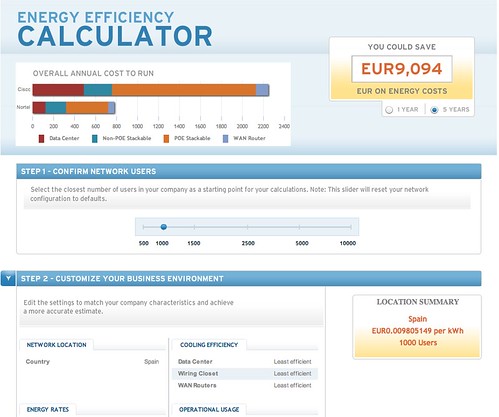
Nortel Energy Efficiency Calculator

Nortel announced the release their Energy Efficiency Calculator online last week.

The tool is available for anyone to use after a quick registration (name, email and country) and uses best guestimates to give figures for energy spend.

The data are highly customisable, you can vary country, energy costs, company setup (network, no. of employees, etc.). It outputs costs to run the network infrastructure, kWh consumed, MBTUs generated and CO2 emissions.

This is an extension of the “Cisco Energy Tax” campaign which Nortel have been running very successfully now for some time.

It would be nice to see easy totals calculated for the outputs (possibly they are there but I didn’t see them) and it would be far nicer if it were not coded in Flash!

Having said that, this is a neat tool and reinforces the connection for companies between saving costs and lowering CO2 emissions.

Now Cisco, where is your rebuttal? ;-)

See the video below for more:

[Disclosure: Nortel are a GreenMonk client]

by-sa

More reasons for agreed standards and lower carbon footprints

Verizon
Photo Credit runway27r

I was at a BT analyst briefing during the week and at this meeting I was delighted to hear Donna Young, BT’s Head of Climate Change say that amongst other things, BT are going to start requiring suppliers to follow the BT ethos on carbon footprinting. They will be auditing suppliers on a scale of 0-3 where 0 means the supplier hasn’t started working on their carbon footprint yet and 3 indicates that they have auditable results. Further, BT will be using this scale to rule companies into or out of tender processes. Excellent.

Then this evening via April and via Bo in Nortel I came across the release from Verizon where they announced that from January 1st 2009 their target is for new gear from their suppliers to be 20% more energy efficient.

Mark Wegleitner, Verizon’s senior vice president-corporate network and technology said:

The Verizon network requires power costing hundreds of millions of dollars annually to provide the most advanced services available anywhere in the world. The energy dollars are well spent, as the network supports consumers and businesses in dynamic new ways. For example, our customers engage in energy-efficient activities like videoconferencing and e-commerce every day over our network.

Aside from the potential cost reductions involved, as a responsible corporate citizen, we want to be part of the drive toward greater energy efficiency. Part of our plan to accomplish this is to request our suppliers’ help in meeting our conservation goals.

Verizon are ahead of the curve in this respect. In fact, as I noted previously, there are no agreed standards against which to measure equipment so Verizon went ahead and wrote ther own:

Verizon established a series of Telecommunications Equipment Energy Efficiency Ratings based on formulas that test the consumption of equipment in various operating conditions and settings. Test data are entered into formulas developed for each type of equipment, which will indicate whether or not they achieve the target rating…. The concepts and measurement methods have been submitted for consideration by appropriate standards bodies, such as ATIS’ Network Interface, Power and Protection Committee (NIPP).

There is still a dearth of agreed standards around carbon accounting and energy efficiency. It is interesting to see, in the absence of such standards, companies coming up with their own and starting to use these measures as part of their purchasing process. Increasingly your company’s carbon footprint will not alone affect your energy costs but will also start to affect your sales.

More reasons for agreed standards and lower carbon footprints!

by-sa

IPv6: Towards a Greener Internet

As you probably know by now, we’re very interested in the idea of what might constitute a green API or protocol, so I was very interested when I received a link via twitter from @Straxus (Ryan Slobojan).

The Aon Scéal? (That’s Any News in Gaelic) blog by Alastrain McKinstry points to this piece by Yves Poppe which argues that IPv6 could save 300 Megawatts.

Easy to forget that most mobile devices used by Time Square revelers were behind IPv4 NAT’s and that always on applications such as Instant Messaging, Push e-mail, VoIP or location based services tend to be electricity guzzlers. It so happens that applications that we want always to be reachable have to keep sending periodic keepalive messages to keep the NAT state active. Why is that so? The NAT has an inactivity timer whereby, if no data is sent from your mobile for a certain time interval, the public port will be assigned to another device.

You cannot blame the NAT for this inconvenience, after all, its role in live is to redistribute the same public addresses over and over; if it detects you stopped using the connection for a little while, too bad, you lose the routable address and it goes to someone else. And when a next burst of data communication comes, guess what? It doesn’t find you anymore. Just think of a situation we would loose our cell phone number every time it is not in use and get a new one reassigned each time.

Nokia carried out the original study. Good work Nokia researcher guys! Another way of looking at the saved energy, which I think we’d all vote for, is potentially longer battery life of our mobile access devices. I am sure the folks at Nortel, who are so enthusiastically driving the green agenda for competitive advantage, would be interested in this research, and quite honestly its one of the first arguments I have heard that makes me think ah yes IPv6 lets pull the trigger. There are some good skeptical arguments in the comments here, but on balance I can definitely see the value of the initial research. Its surely worth further study.

While writing this article I also came across the rather excellent Green IT/Broadband blog. The author clearly believes in our Bit Miles concept, even if he doesn’t call it that.

Governments around the world are wrestling with the challenge of how to reduce carbon dioxide emissions. The current preferred approaches are to impose “carbon” taxes and implement various forms of cap and trade or carbon offset systems. However another approach to help reduce carbon emission is to “reward” those who reduce their carbon footprint rather than imposing draconian taxes or dubious cap and trade systems. It is estimated that consumers control or influence over 60% of all CO2 emissions. As such, one possible reward system of trading “bits and bandwidth for carbon” is to provide homeowners with free fiber to the home or free wireless products and other electronic services such as ebooks and eMovies if they agree to pay a premium on their energy consumption which will encourage them to reduce emissions by turning down the thermostat or using public transportation. Not only does the consumer benefit, but this business model also provides new revenue opportunities for network operators, optical equipment manufacturers, and eCommerce application providers.

European IPv6 Day, hosted by the EU is on the 30th May. Come to think about it the guy I should talk to about green IP is Vint Cerf of Google.

by-sa