Tag Archive for 'energy savings'

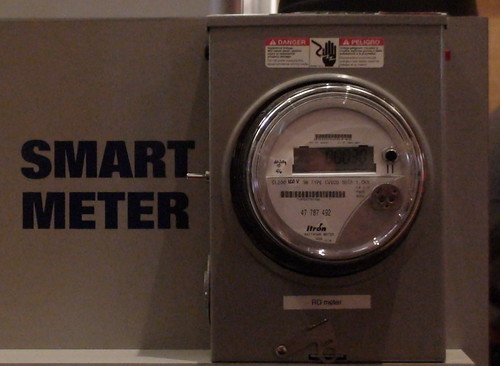
Britain readies for nation-wide Smart Meter rollout

Smart Meter

An article in the UK’s Sunday Times recently talked about the plans for a nationwide rollout of Smart Meters in Britain.

From the article:

Telecoms giants Vodafone, O2 and BT and system integrators Logica, Accenture, IBM and Capgemini are understood to have started talks to form bidding consortiums…

The government has put smart meters at the heart of its energy policy but progress on its implemen-tation has been slow. A consensus has emerged recently between the Department for Energy and Climate Change, Ofgem, the regulator, and the big six utility companies over how it will be done.

Each utility will be responsible for fitting new meters for its customers, starting a roll-out from 2010…

To ensure transparency, a “central communications” group would be set up to electronically collect, process and distribute data and serve as the go-between for energy companies and the meters in their customers’ homes…

Ofgem is expected to run the tender for the contract, which would operate from 2010 to 2020. The winning group would likely consist of a telecoms provider and a systems integrator. There is an outside chance that the contract could be broken down regionally.

This is great news for Britain as it will allow for demand response projects to be rolled out with the consequent nationwide energy savings and the possibilities to increase the penetration of renewables on the grid. Ireland continues to drag its feet in this area with a limited pilot to begin next year. With the irish government hoping to reach 40% penetration of renewables by 2020, they really need to pick up the pace if they want to come anywhere near achieving that target.

by-nc-sa

If you enjoyed this post, make sure you subscribe to my RSS feed!

How to make a hosting company carbon neutral - René Wienholtz of Strato

CO2
Photo Credit \<

Audio clip: Adobe Flash Player (version 9 or above) is required to play this audio clip. Download the latest version here. You also need to have JavaScript enabled in your browser.

Episode 4 of the GreenMonk Podcasts - 36 mins 28 secs

My guest on this podcast is Strato’s Executive Director for Information Technology and Innovation Rene Wienholtz.

Strato are Europe’s second largest hosting company and Strato are also carbon neutral! Amazingly they achieved this without buying any offsets. How did they do it?

Listen to René explain it.

Here are the questions I asked René and the approx. times I asked them:

Can you tell us something about your own background first and who are Strato? - 00:34

If I heard you correctly you are now the largest hosting company in Europe? - 02:28

You guys are a bit like RackSpace in the sense that you don’t do co-location, you rent space on your servers, id that right? - 02:38

You mentioned that you decided to re-architect the setup in Strato and reduce your carbon footprint, was this for environmental reasons or business reasons? - 03:34

Questions from readers:

Jiri Ludvik
what percentage in carbon reduction they achieved by each of the step you mention? - 05:48

Do you use underfloor plenums as well to direct the air to the cold aisles? - 21:47

Can you talk to us too about the energy savings you are getting from buying CO2 free energy? - 25:44

Have you negotiated a set price from your clean energy supplier for a set period? - 29:36

Can you tell me how long this price is guaranteed for? - 30:15

Have you had any independent 3rd party certify that you are carbon neutral? - 30:27

More questions from readers:

Jim Hughes
Has the carbon saving had a real cost benefit? Or have the lower power costs been exceeded by the premium for carbon neutral electricity? - 31:42

Would you recommend other hosting providers take the same route? - 32:53

Do you think environmental awareness is an area where European hosting companies have a head start over the US? - 34:47

Download the entire interview here
(33.4mb mp3)

by-sa

If you enjoyed this post, make sure you subscribe to my RSS feed!

ICT could deliver approximately 7.8 GtCO2e of emissions savings in 2020

Measuring time
Photo Credit aussiegall

James has, in previous posts referred to the fact that IT is responsible for 2% of the world’s CO2 emissions but that it can have a disproportionate influence on the other 98%. This is something we believe fundamentally in GreenMonk so it is great to see others vindicating our position.

The Climate Group and the Global e-Sustainability Initiative (GeSI) recently published a report, independently audited by McKinsey and Company called Smart 2020. The report is a fascinating read and comes to the conclusion that ICT could:

deliver approximately 7.8 GtCO2e of emissions savings in 2020. This represents 15% of emissions in 2020 based on a BAU [Business As Usual] estimation. It represents a significant proportion of the reductions below 1990 levels that scientists and economists recommend by 2020 to avoid dangerous climate change. In economic terms, the ICT-enabled energy efficiency translates into approximately €600 billion ($946.5 billion) of cost savings. It is an opportunity that cannot be overlooked.

Apart from emissions associated with deforestation, the largest contributors to climate change are transportation and power generation, so how could IT help these functions?

According to the report the use of

  1. Smart motor systems - optimised motors and industrial automation would reduce 0.97 GtCO2e [0.97 giga tons CO2 emissions] in 2020, worth €68 billion ($107.2 billion)
  2. Smart logistics - global savings from smart logistics in 2020 would reach 1.52 GtCO2e, with energy savings worth €280 billion ($441.7 billion)
  3. Smart buildings - smart buildings technologies would enable 1.68 GtCO2e of emissions savings, worth €216 billion ($340.8 billion) and
  4. Smart grids - smart grid technologies were the largest opportunity found in the study and could globally reduce 2.03 GtCO2e , worth €79 billion ($124.6 billion)

Even though we have been heavily promoting the use of smart grids and demand response on this blog I was impressed that they could reduce CO2 emissions by 2 giga tons by 2020. This is one of the reasons why I was super-excited today when SAP’s Mike Prosceno invited me to attend their SAP for Utilities conference which is going to be in San Antonio Texas in October. This is a conference about the future of utilities and there will be a big focus on smart grids, smart meters and AMI (Advanced Metering Infrastructure).

How will IT help reduce emissions? It comes back to that old chestnut - if you can’t measure it, you can’t manage it.

Or as Steve Howard, CEO, The Climate Group said in his opening address in the report:

When we started the analysis, we expected to find that ICT could make our lives ‘greener’ by making them more virtual – online shopping, teleworking and remote communication all altering our behaviour. Although this is one important aspect of the ICT solution, the first and most significant role for ICT is enabling efficiency.

Consumers and businesses can’t manage what they can’t measure. ICT provides the solutions that enable us to ‘see’ our energy and emissions in real time and could provide the means for optimising systems and processes to make them more efficient. Efficiency may not sound as inspirational as a space race but, in the short term, achieving efficiency savings equal to 15% of global emissions is a radical proposition.

Via Doug Neal (aka gblnetwkr)

by-sa

If you enjoyed this post, make sure you subscribe to my RSS feed!