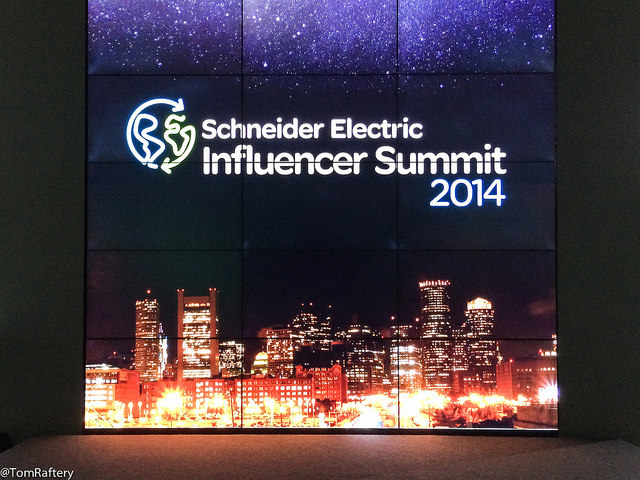
We were invited to attend this year’s Schneider Electric Influencer Summit and jumped at the chance. Why? Schneider Electric is a fascinating company with fingers in lots of pies, and we were keen to learn more about this company.
Schneider Electric was founded in 1836, so the company is coming up on 180 years old. Schneider reported revenue of almost €23.5bn in 2013, of which €1.9bn was profit, and employs in the order of 152,000 people globally. So, not an insignificant organisation.
The Influencer Summit coincided with the opening of its Boston One campus, Schneider Electric’s new facility in Andover. This site is now Schneider’s main R&D lab, as well as its North American HQ. Situating its main R&D labs in its HQ says a lot about how Schneider views the importance of research and development. In fact, at the event Schneider EVP and North American CEO Laurent Vernerey, reported that Schneider devotes 4-5% of sales to R&D annually.
At the influencer event, we discovered the breath of Schneider’s portfolio went far beyond what we were aware of. Not only are they heavily involved in electrical automation, control and distribution systems, but they also help make highly energy efficient data centres (they bought APC back in 2007), they have building management solutions, a cybersecurity suite (developed especially for critical infrastructure), water management solutions, a smart cities business, a weather forecasting arm (with a staff of 80 meteorologists!), and a strong services division. See, fingers in lots of pies!
Schneider Electric, as its name suggests, was traditionally more of a hardware company, but with the move to the digitisation of infrastructure, that has changed fundamentally, and Schneider is now very much a software company as well as a hardware one. Of the 20,000 employees in North America, 1,200 are software engineers.
This digitisation of infrastructure is happening at an ever increasing pace, helped by the constantly falling price of electronics and sensors. If it costs a mere $2.50 to put an SoC on a piece of infrastructure, why wouldn’t you do it? Particularly when adding the SoC makes the device IP addressable. Now it can report back on its status in realtime. As Schneider CMO Chris Hummel said, “connected systems will fundamentally change everything”.
Addressing potential security issues associated with making critical infrastructure IP addressable Schneider said that connected devices are more secure than disconnected devices because they can be monitored, and everything that’s done to them can be tracked.
With that in mind, it is not surprising that Schneider is a member of the Industrial Internet Consortium.
While it is always instructive to hear a company’s executives talking about their organisation, it is always far more interesting to hear their customers speak. And this event didn’t disappoint on that score. The customer speaker in this case was Todd Isherwood, the Energy Efficiency and Alternative Energy project manager for the City of Boston. Todd discussed how the City of Boston, with 15,000 employees, 2,700 utility accounts and a $50m electricity spend was working with Schneider Electric on its journey to becoming a more sustainable city.
Boston launched its Greenovate Boston campaign, it passed its Building Energy Reporting and Disclosure Ordinance (BERDO). This Ordinance requires Boston’s large- and medium-sized buildings to report their annual energy and water use to the City of Boston, after which the City makes the information publicly available. All of which will have helped Boston achieve its ranking of most energy efficient city in the US.
The biggest takeaway from the event though, was that Schneider Electric is, at its core, hugely interested in helping organisations become more efficient. And seemingly for all the right reasons. That’s not something you can say about many companies. And because of that, we’ll be watching Schneider with great interest from here on out.
Disclosure – Schneider Electric paid my travel and accommodation expenses to attend this event.