
Your company’s share price can be negatively affected if you fail to behave responsibly in your business practices.
I have written here a couple of times about environmental risks companies could potentially face. This first time I wrote about this it was in reference to FaceBook’s decision to source the power for their new data center from a utility which uses coal-fired power primarily.
I followed that up with a post about how the EPA, the SEC and institutional investors are becoming more interested in environmental risk, asking companies to report on risks which may impact on a business’ sales, properties or even their reputation.
The importance of this has been driven home forcibly over the last couple of days as GreenPeace launched an international campaign targeting Nestl?. Why? Because it turns out Nestl? is purchasing palm oil from companies whose plantations cause deforestation of Indonesian rainforests with all the attendant knock-on effects this has (massive CO2 emissions, indigenous communities destroyed, and devastation of the Orang-utan’s habitat to name but a few).
As part of the campaign, Greenpeace launched a report called Caught Red Handed [PDF] outlining the connections between Nestl?, their suppliers and habitat destruction in Indonesia. As part of the launch campaign, Greenpeace had people on the ground at Nestl? offices in Orang-utan costumes publicising the report and they posted a spoof video on YouTube.
Unfortunately Nestl?, decided that instead of fixing their supply chain, that they should go down the censorship route. They quickly contacted Google and had the video removed from YouTube. Nestl? didn’t reckon with the Streisand effect though and in very short order the video was posted on vimeo and promptly re-posted on many other sites.
Nestl?’s lawyers quickly abandoned the take-down option realising they’d merely be playing a game of whack-a-mole if they continued. The storm of publicity which ensued even spread as far as CNN and within 24 hours Nestl? was forced to backtrack . The video is now back up on YouTube.
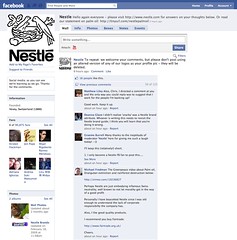
As these things do, the debate took place on FaceBook and Twitter too with many people calling for a boycott of Nestl? products! In a classic social media shot to the foot Nestl? warned people:
we welcome your comments, but please don’t post using an altered version of any of our logos as your profile pic – they will be deleted.
Now, in any social media forum (or any forum for that matter), threatening people with censorship is definitely not a way to win friends or influence people. And predictably this threat inflamed an already upset audience. The censorship threat went viral and Nestl?’s reputation went into freefall.
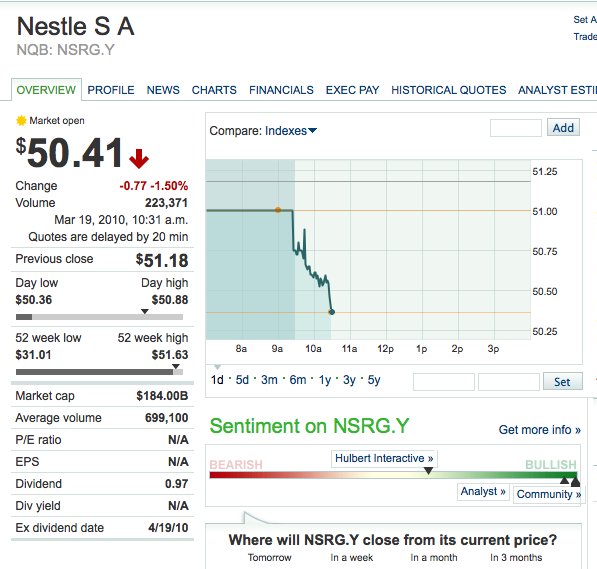
The end result, as you can see at the top of this post, Nestl?’s stock price fell too.
This was eminently preventable.
And it is a clear demonstration of the need to be fully aware of all the potential risks in your supply chain.
If Nestl? was utterly transparent and ethical in its business practices, then it couldn’t have been ambushed by Greenpeace.
If Nestl? had ensured that its supply chain was completely free of controversy it would have avoided the pr storm, the reputational damage and the financial losses from loss of sales and the fall in its share price.
I’d be the last to argue that corporate reputation can’t affect a company’s bottom line – positively via the halo effect or negatively after the launch of a campaign by an NGO. But according to my research (http://ow.ly/1oRoJ) shares closed Friday at $50.36, down a mere 40 cents from the opening trading price of $50.76. You’ll see the 52-week trading range is $31.01-$51.63, so trading at above $50 is the high end of the share price range for the entire year. (I don’t pretend to be an expert on the stock market, but I did work for a Canadian financial newspaper for three years with some people who actually did.)
I’ve also worked with companies whose reputations and share prices were adversely affected by their corporate reputations, faced delisting on major exchanges, and were threatened with various trade embargos of their goods.
What I’m trying to say here is that you can’t just take a look at a single day’s trading to establish that an NGO campaign has actually had a deleterious affect on a company’s share price – or on its corporate reputation. A much longer-term study is required. And I can’t imagine that Nestle isn’t aware of this and that sooner or later someone at the company will take appropriate action to deal with it (as opposed to the current floundering that’s going on in mid-March of 2010).
Issues management is always a tough sell to corporate clients and if you’ve worked in issues management for a global PR firm, you’ll know that the mantra amongst PR issues and crisis management practitioners is, ‘if only they had called us sooner we could have done more to mitigate the issues and avoid the crisis, but that’s the nature of the beast.’
i think Ruth and Dennis raise a very solid point. One day of trading does not a rout make.
“the reputational damage and the financial losses from loss of sales” – is conjecture for now.
I also can’t help thinking Nestle’ has weathered these storms before. Dumping of baby formula has been a long running issue for the firm in reputational terms.
Thanks for the post. Going to use this with my Leaving Certificate Business class tomorrow. Currently doing the chapter on the LC Business course on social responsibility and business ethics. Excellent example.