Tag Archive for 'international energy agency'

Peak oil is here - now what are you going to do about it?

Congressman Roscoe Bartlett [R] in the video above addresses the US congress on the liklihood that we have hit peak oil.

Congressman Bartlett has been banging this drum since 2005 but he received an unlikely ally in the International Energy Agency yesterday! The IEA is not known for being alarmist and is typically extremely conservative in these matters however yesterday’s Medium-Term Oil Market Report from the IEA contained some interesting nuggets which suggest that they are coming around to the “Peak Oil is here now”, way of thinking.

Nobuo Tanaka, Executive Director of the International Energy Agency speaking at a press conference at the World Petroleum Congress, emphasized that market fundamentals were the main underlying factor behind high oil prices. “OPEC production is at record highs and non-OPEC producers are working at full throttle, but stocks show no unusual build. These factors demonstrate that it is mainly fundamentals pushing up the price,” he added.

In other words, no build up of stocks means it is a simple case of supply and demand, not speculators, which is causing the current price increase.

This is not good news.

The report goes on:

Over 3.5 mb/d of new production will be needed each year just to hold global production steady. “Our findings highlight again the need for sustained, and indeed, increased investment both upstream and downstream — to assure that the market is adequately supplied,” stated Mr. Tanaka.

But figures for new production have been falling year-on-year, never mind increasing 3.5mb/d.

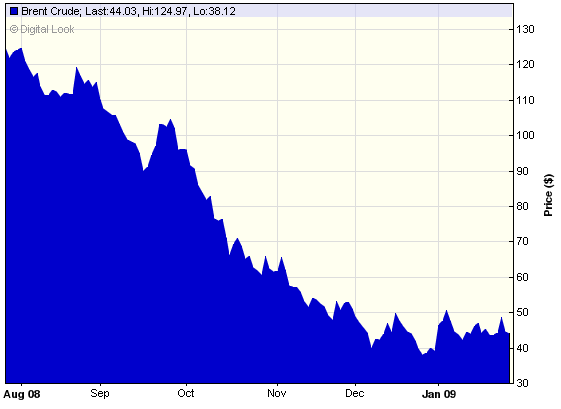
Ok, so if we say peak oil has arrived and we are never again going to see a barrel of oil go below $120 per barrel (in fact it will trend ever upwards over time), just what are you going to do now that you have that information?

Will you start an efficiency drive in your company? Remember your financial accounting - saved overhead goes straight to the bottom line!

Will you buy a hybrid car? Will you install solar/wind generation capacity at your place of work/home? Will you go vegetarian?

We are headed into challenging times but for people and companies who make the right choices, there is, as ever, money to be made!

by-sa

IEA report paints challenging picture

Nuclear power
Photo Credit mobileart

I read the International Energy Agency’s latest Energy Technology Perspectives 2008 report and it is sobering stuff.

It starts off by outlining what will happen in a business as usual scenario:

Our current path is not sustainable
If governments around the world continue with policies in place to date – the underlying premise in the ETP Baseline scenario to 2050 – CO2 emissions will rise by 130% and oil demand will rise by 70%. This expansion in oil equals five times today’s production of Saudi Arabia.

What is worse, according to the report, despite recognition of the problem, CO2 emissions have grown considerably in recent years.

Higher oil and gas prices result in a rapid switch to coal. Moreover rapid growth in China and India, both coal-based economies, has also contributed to this deteriorating outlook.

Getting CO2 emissions even back to 2005 levels by 2050 will pose massive challenges -

No single form of energy or technology can provide the full solution. Improving energy efficiency is the first step and is very attractive as it results in immediate cost savings. Significantly reducing emissions from power generation is also a key component of emissions stabilisation. But even this is not enough.

However, getting us to 50% of the 2005 emissions by 2050 means that

Total additional investment needs in technology and deployment between now and 2050 would amount to USD 45 trillion, or 1.1% of average annual global GDP over the period”, Mr. Tanaka stressed.
We would need a virtual decarbonisation of the power sector. Given the growing demand for electricity, this would mean that on average per year 35 coal and 20 gas-fired power plants would have to be fitted with CO2 capture and storage (CCS) technology, between 2010 and 2050 at a cost of USD 1.5 billion each. Furthermore, we would have to build an additional 32 new nuclear plants each year and wind capacity would have to increase by approximately 17.500 turbines each year.

32 new nuclear plants every year between 2010 and 2050? Wow! I wonder if the authors have read the Rocky Mountain Institute report on nuclear energy which says

Construction costs worldwide have risen far faster for nuclear than non-nuclear plants, due not just to sharply higher steel, copper, nickel, and cement prices but also to an atrophied global infrastructure for making, building, managing, and operating reactors. The industry’s flagship Finnish project, led by France’s top builder, after 28 months’ construction had gone at least 24 months behind schedule and $2 billion over budget.

Unless something drastic happens in the next few years we will be lucky if our CO2 emissions in 2050 are not higher than they were in 2005. And that has dire implications for the health of the planet.

by-sa